

Contributor:
AHF Thailand
What if the next HIV testing site isn’t a clinic, a bar or a community center but a social media app?
For decades, HIV outreach teams have gone where people gather: bars, saunas, public parks and other cruising areas. Community-based organizations (CBOs) played an important role in bringing HIV services directly to these spaces. But the way people connect has changed. Conversations, communities and opportunities to meet new people increasingly happen online.
For HIV programs, this shift presents both a challenge and an opportunity: if cruising areas are moving online, can HIV outreach move there too?
For AHF Thailand, the answer was to rethink how targeted outreach could work in the digital space. In 2022, the team began piloting Targeted Online Outreach Testing (TOOT) using social media to identify people who may be at risk, engage them privately and connect them directly to HIV testing and care.
“Albert Einstein once said, ‘Insanity is doing the same thing over and over but expecting different results.’ The outreach landscape has changed. Places like bars, saunas and public parks have moved online, and so have people’s behaviours. We needed a different strategy to reach them.”
— Kritsiam Arayawongchai,
Country Program Director, AHF Thailand

The idea was not to simply put existing outreach messages online. It was to understand where people are, how they communicate and what would motivate them to take the next step toward testing.
Taking HIV Outreach Online
In September 2022, AHF Thailand piloted Targeted Online Outreach Testing (TOOT) across six sites: Taksin Hospital, Ratchaburi Hospital, Khon Kaen Hospital, Udon Thani Hospital, Sunpasit Hospital and Hatyai Hospital.
Rather than waiting for people to come to physical outreach locations, trained volunteers were supported to identify priority populations through social media platforms and engage potential clients privately. They provided HIV and STI prevention information, answered questions and connected people with testing and, when needed, treatment and care.
The approach combined three elements: behavior change communication, targeted social media engagement and cost-effective testing.
Volunteers were trained not simply to post health information, but to understand where different populations were active online, identify relevant keywords and behaviors, craft engaging messages, respond to questions and provide a clear pathway to testing.

“Knowing how to use social media wasn’t enough. We had to know where our target audiences were, how to reach them, create messages that capture attention in three seconds, and end with a clear call to action. A simple post takes a lot of strategy behind it.”
— Komon Sapkunchorn,
Program Officer, AHF Thailand

Furthermore, the approach helps close the gap between identifying people who may be at risk and connecting them with health services:
“This project perfectly bridges the gap in our outreach. By reaching the right people on the right platforms at exactly the right time, we can connect those who are truly at risk and smoothly guide them into testing and treatment.”
— Pawat Borisut,
Program Coordinator, AHF Thailand


From Pilot to Results
The four-month pilot demonstrated that targeted online outreach could identify people with HIV and other STIs who might not otherwise be reached through conventional outreach.
Across the six sites, the pilot recorded 439 counseling sessions, 192 HIV tests, 56 syphilis tests and 40 people newly identified as HIV-positive. HIV positivity ranged from 15.79% to 27.78% during the pilot period.
Encouraged by these results, AHF Thailand expanded the model from six to 10 sites in 2023, while extending implementation from four to nine months. HIV positivity remained high, ranging from 19.42% to 30.08%, demonstrating the potential of targeted online outreach to reach people with a higher likelihood of HIV exposure.
The approach also demonstrated a significant difference in cost-effectiveness. Over nine months in 2023, targeted online testing identified 212 HIV-positive cases at a cost of approximately THB 279,000. By comparison, community outreach testing over 12 months identified 201 HIV-positive cases at approximately THB 3.58 million.
This translated into a cost per HIV-positive case that was approximately 13.5 times lower through targeted online testing.

“We spent around THB 60,000–70,000 on each community outreach testing activity, often finding zero to four positives. With this strategy, our cost per positive has dropped from around USD 2,000–2,500 to as low as below USD 20. It’s a highly cost-effective approach.”
— Kritsiam Arayawongchai, Country Program Director, AHF Thailand


Making Testing Easier and More Private
For volunteers and healthcare partners, the online approach also helped reduce barriers between first contact and accessing services.
“Before, patients faced complicated steps and long waits. This project makes access simple, fast, and private. The app helps us reach people without hesitation and provide support right away. The best reward is seeing them leave feeling safe and confident.” — Pratchaya Socket, Project Officer, Udon Thani Hospital
By engaging people through platforms they already use, the model can create trust before someone enters a healthcare facility. It also allows healthcare providers and outreach workers to respond to questions privately and guide people toward appropriate testing and prevention services.


From Thailand to Asia
What began as a small pilot in Thailand has since developed into a regional model.
Regional scale-up began in 2024, reaching 14 sites across four countries. In 2025, the program expanded to 47 sites across additional countries, and by 2026, the regional approach had reached 68 sites across 10 countries.
The proportion of people reached online who subsequently went for HIV testing increased from 57% in 2024 to 82% in 2026. Across the region, HIV positivity was around 10% in 2024 and 2025 and 7% in mid-2026, while syphilis positivity remained around 11–13%.
Thailand continues to demonstrate the potential of the approach. In 2025, HIV positivity among people reached through TOOT was 30.6%, compared with 2.3% through community testing. The cost per HIV-positive case was approximately US$17.74 through TOOT, compared with US$432.08 through community testing.
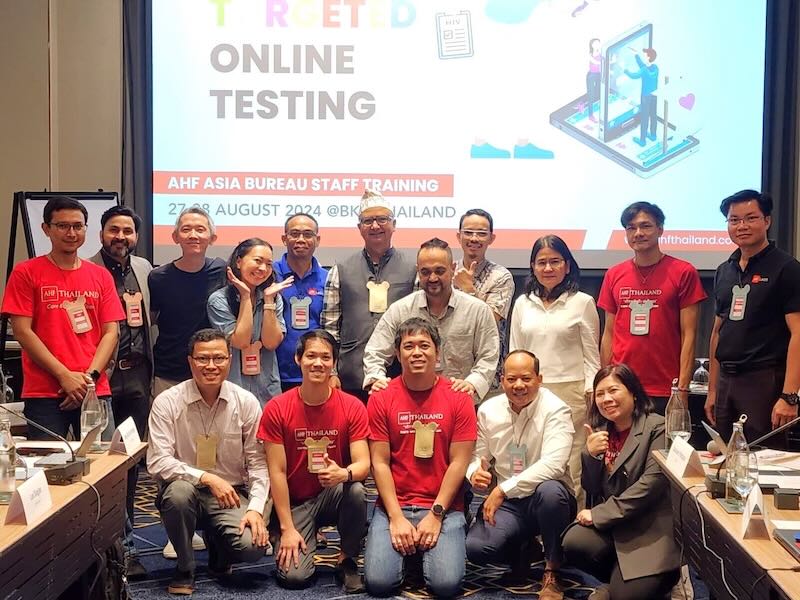
For Ung Kim Heang, Regional Testing and Prevention Manager, AHF Asia Bureau, the model’s practicality was one of its strongest features:
“What caught my attention was its practicality. It goes where people communicate, identifies online communities, engages people privately and connects them directly to testing and care.”

The experience also highlighted that digital outreach is not simply about using more technology. It requires understanding the online landscape, selecting the right peers, choosing the right platforms and maintaining strong follow-up.


Challenges and the Way Forward
The model is not without challenges. Volunteers have different levels of social media experience and different understandings of how targeted outreach works. Finding the right volunteers, building their skills and keeping them engaged requires continuous mentoring and learning.
The experience of AHF Thailand also showed that online outreach needs to evolve alongside the digital environment. Platforms, online behaviors and the ways people communicate continue to change, meaning outreach teams must regularly reassess where and how to engage priority populations.
Moving forward, AHF Thailand aims to strengthen targeting, explore emerging platforms, better identify people at higher risk, including men and women outside traditionally targeted populations, and expand the approach through continued peer learning and integration with testing services.
From physical cruising areas to digital spaces, the experience of AHF Thailand shows that effective HIV outreach does not always require more resources, it may require a different way of reaching the people who need services most.
What started as a pilot in Thailand is now helping shape a regional approach to HIV testing: meet people where they are, understand how they communicate, and make the path to testing and care simpler, more private and more accessible.