
Launched by the Joint United Nations Programme on HIV/AIDS, UNAIDS on 28 November, the World AIDS Day Report: Let Communities Lead calls for the removal of obstacles to community leadership.
Much of the progress made against the HIV pandemic over the last 40 years is thanks to the efforts of community-based organizations. Communities play a vital role in connecting people with HIV services and in reaching people most affected by HIV. However, the report reveals how communities working on HIV/AIDS are too often unrecognized, under-resourced and in some places even under attack.
Governments and Donors must enable, support, empower and resource communities in their work in preventing, preparing for and responding to pandemics of the future.
“In 2012, over 31% of all HIV resources were channeled through civil society organizations, in 2021, only 20% of funding for HIV was allocated for civil society—an unprecedented backsliding in commitments which is costing lives.”
Asia and the Pacific Data (2022)
| People Living with HIV | New HIV Infections | AIDS-related deaths |
| 6.5 million | 300,000 | 150,000 |
Source: https://www.unaids.org/sites/default/files/media_asset/UNAIDS_FactSheet_en.pdf
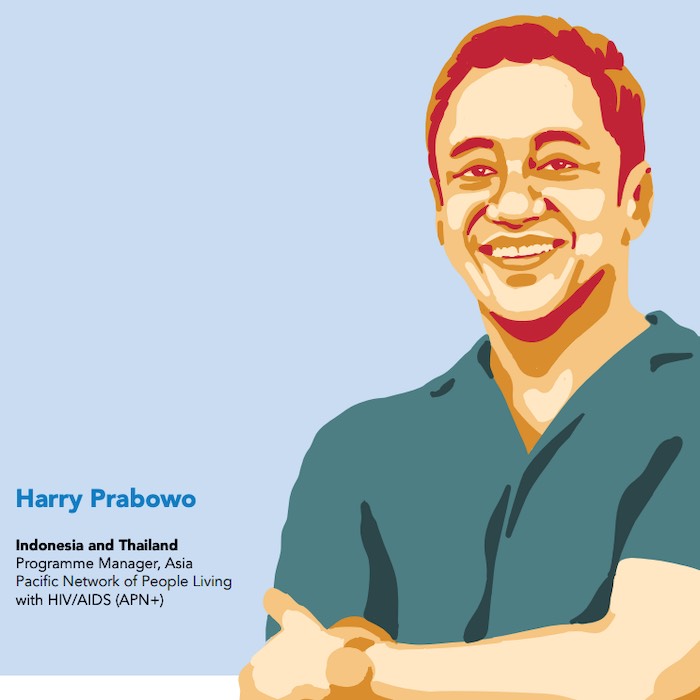
Harry Prabowo
Programme Manager
Asia Pacific Network of People Living with HIV/AIDS (APN+)
shared his story:
“To support communities, invest in them.
I am alive because of the community. When I was diagnosed with HIV in Jakarta in 2010, I had a CD4 count of 20. Staff at my nongovernmental organization took me to the doctor. They took turns looking after me. They were with me as I took my first steps after starting treatment. They held my hand. They made me laugh.
Today, I not only have an undetectable viral load, but I also have the confidence to embrace life fully and proudly as a gay man living with HIV. Treatment on its own could not get me here.
I have been lucky. But to ensure the world can end AIDS as a public health threat, community-led support cannot be left to luck.”
COMMUNITY-LED INNOVATION WITH SOCIAL MEDIA
TO INCREASE ACCESS TO HIV PREVENTION IN SOUTHEAST ASIA

Based in Bangkok, APCOM is a community-led organization that works to improve the health and rights of gay men and other men who have sex with men and LGBTQI people across the Asia and Pacific region (64). Its work focuses on three pillars—strengthening the HIV response, protecting and promoting the human rights of gay men and other men who have sex with men, and building community and stronger partnership networks.APCOM is an energetic and innovative implementer of virtual interventions, actively creating demand for HIV services with specifically tailored approaches for community members.Its testBKK Party Pack initiative, which started in Bangkok and is now being replicated in the capital cities of Cambodia, Indonesia and the Philippines, promotes the access of young gay men and other men who have sex with men to sexual health services, including condoms and lubricants, safer sex information, including for people who engage in chemsex, HIV testing and PrEP.
The initiative targets people who fear buying condoms and lubricants from public places—a common issue for young gay men and other men who have sex with men in the region. It is also an effort to reach the people who are hard to reach, who are not identified by conventional in-person outreach, and who regularly find their sexual partners online (information provided by UNAIDS Regional Support Team for Asia and the Pacific, 2023).
For more information, visit www.testbkk.org