
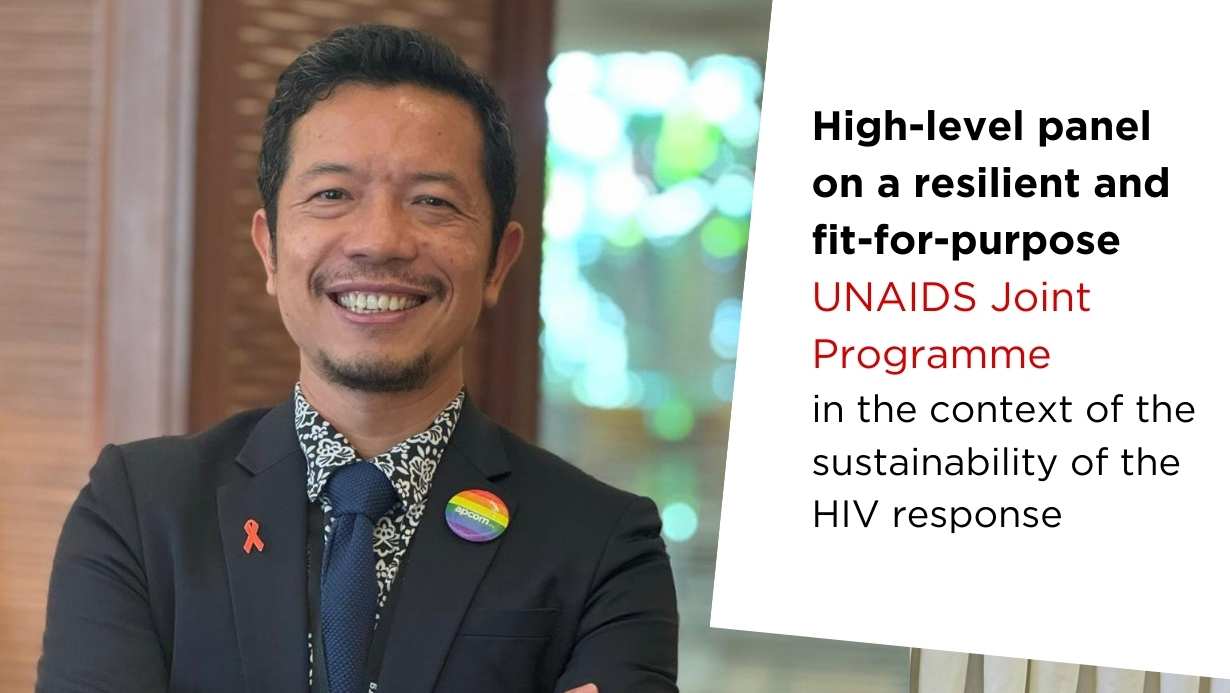
APCOM, represented by its Executive Director, Midnight was on the High-level panel on a resilient and fit-for-purpose UNAIDS Joint Programme in the context of the sustainability of the HIV response.
The High-Level Panel was tasked with developing recommendations to the UNAIDS Executive Director and the UNAIDS Committee of Cosponsoring Organizations (CCO) to inform their response to the PCB decision point, towards envisaging a ‘fit-for-purpose’ UNAIDS Joint Programme that builds on the success of the current AIDS response but is cognizant of the evolving nature of the AIDS epidemic as well as the changing landscape of the political, social and economic context of the epidemic. The Panel has sought to examine what a “resilient and fit-for-purpose” operating model would look like in the context of the global AIDS response leading up to 2030 and beyond.
The following guiding questions informed the Panel’s recommendations:
- What is required for the Joint Programme to execute and implement its added value to end the AIDS epidemic as a public health threat by 2030?
- What is the operating model that can help execute this vision?
- What expertise is required to deliver on the Joint Programme’s specific added value, and how should the expertise be translated into an organizational structure?
- What is needed at both the global and national levels to support a “resilient and fit-for-purpose” operating model?
- What funding will enable a fit-for-purpose Joint Programme?

APCOM Executive Director, Midnight commented,
“It was an honour for APCOM to be one of the seven community members on the High Level Panel. We were the only one from Asia and the Pacific region, so the pressure was on to ensure that we have voices and data from the region to ensure that our region, and key population including men who have sex with men, transgender people, people who use drugs, sex workers, people living with HIV and young key populations are not left out in the global HIV response.”
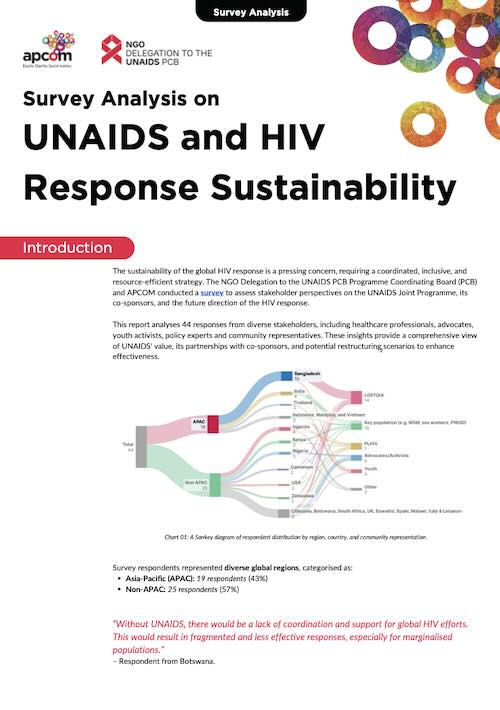
To ensure broader community engagement, APCOM partnered with the UNAIDS NGO Delegation to develop a survey to assess stakeholder perspectives on the UNAIDS Joint Programme, its co-sponsors, and the future direction of the HIV response.
This report analyses 44 responses from diverse stakeholders, including healthcare professionals, advocates, youth activists, policy experts and community representatives. These insights provide a comprehensive view of UNAIDS’ value, its partnerships with co-sponsors, and potential restructuring scenarios to enhance effectiveness.
As noted by a youth CSO representative from Thailand, “Each Cosponsor brings unique expertise to address the multifaceted challenges of the HIV/AIDS epidemic. For example, WHO contributes medical and technical guidance, UNICEF focuses on children and young people, and UNFPA works on sexual and reproductive health. This specialised knowledge is critical for a comprehensive response.”

“Without the [UNAIDS] Data Hub we’d have a data void on key populations in Asia-Pacific.”
Gaj Gurung, former regional coordinator of Youth Lead
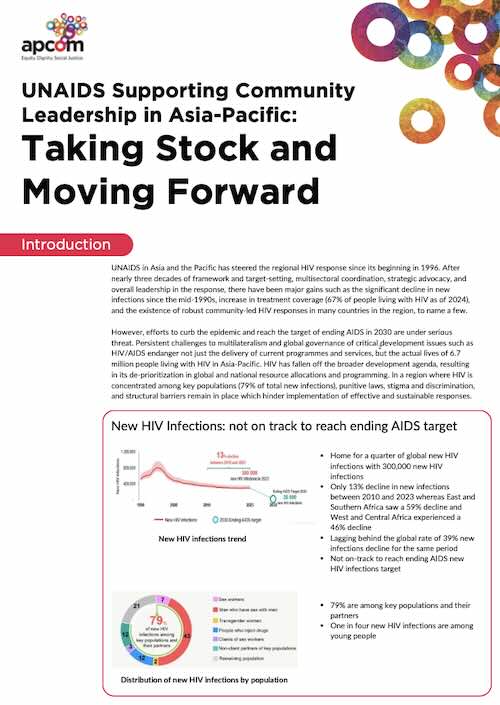
APCOM also produced a stocktake document that outlines the critical role of UNAIDS in the region in an effort to curb the epidemic and reach the target of ending AIDS in 2030 but these are under serious threat. In a region where HIV is concentrated among key populations (79% of total new infections), punitive laws, stigma and discrimination, and structural barriers remain in place which hinder implementation of effective and sustainable responses.Persistent challenges to multilateralism and global governance of critical development issues such as HIV/AIDS endanger not just the delivery of current programmes and services, but the actual lives of 6.7 million people living with HIV in Asia-Pacific.
Read the final report here: