

As APCOM’s term on the UNAIDS PCB comes to an end, we welcome Youth LEAD represented by Jeremy Tan on board who will be working with Sonal Giani of IPPF in 2025 on the NGO Delegation as Asia and the Pacific representatives. Let’s find out more about Jeremy:
Tan Fok Jun (Jeremy) is the program officer of Youth LEAD, a regional youth-led organization that works with young key populations across Asia-Pacific. He has extensive experience in HIV programs with specific focuses on youth access to HIV Prevention, Testing, and Treatment, through global fund’s related processes and different donor supporting mechanisms. His professional work-centred around HIV advocacy, Sexual and Reproductive Health and Right, Comprehensive Sexuality Education, Youth Leadership, Policy and Legislation, and Community Mobilization.
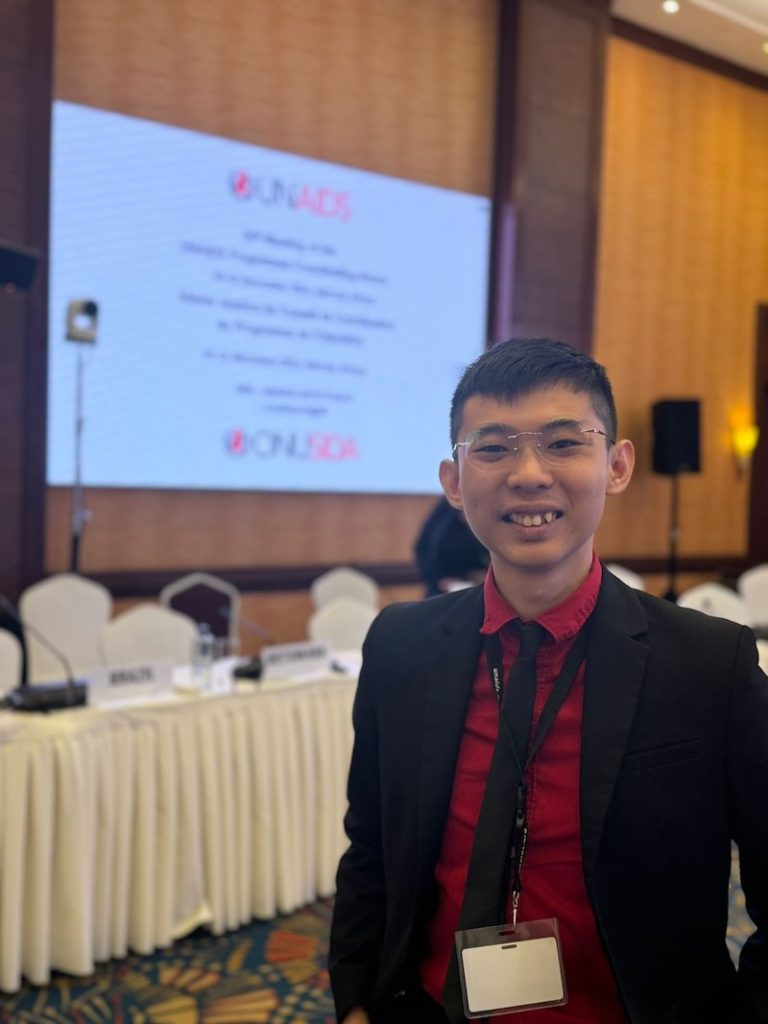
“Carrying the trust of the community and standing on the shoulders of giants who paved the way, I am ready to drive meaningful change in the global HIV response, ensuring young key populations are never left behind.”

Why did you decide to apply to join the NGO Delegation?
I decided to join the NGO Delegation because I believe that meaningful change in the global HIV response requires the voices of young key populations to be front and center. Having worked closely with marginalized communities, I’ve seen firsthand the barriers they face, from stigma and discrimination to limited access to tailored healthcare services. Joining the delegation allows me to advocate for their rights on a global platform, ensuring that their needs and perspectives are included in decision-making processes.
This opportunity is not just a responsibility but a chance to bring the hopes of my community to the table. By working alongside passionate advocates and leaders, I aim to push for policies and actions that prioritize equity, inclusion, and the empowerment of young people in the fight against HIV. Together, we can make strides toward a world where no one is left behind.

Can you give us your reflections on the recent 55nd UNAIDS PCB in Kenya?
The 55th UNAIDS Programme Coordinating Board (PCB) meeting in Nairobi highlighted the indispensable role of community-led responses in addressing gaps in national HIV programs caused by stigma and discrimination. Over three days, I witnessed how these initiatives provide life-saving HIV prevention, testing, and treatment services, complementing government efforts to reach key populations. A site visit reinforced the importance of empowering communities to bridge these gaps effectively.
As the incoming NGO delegate from Asia and the Pacific, I joined the meeting with a commitment to advocate for the principles of the global HIV response. Executive Director Winnie Byanyima opened the agenda by calling for global solidarity and decisive action to address persistent challenges such as funding gaps, systemic barriers, and emerging drug resistance. Her speech emphasized the need for governments, donors, and communities to leverage innovations like long-acting medicines and uphold human rights to end AIDS by 2030.
The NGO report focused on three critical themes: shrinking civic space, anti-rights movements, and unsustainable financing, which undermine global HIV efforts. Throughout the meeting, the NGO delegation made a concerted effort to address these issues. To counter shrinking civic space, we advocated for greater inclusion of community-led organizations in national and global decision-making processes, emphasizing their vital role in delivering HIV services. In response to anti-gender and anti-rights movements, we worked to reinforce the importance of protecting the rights of key populations, including vulnerable and other marginalized groups, as central to an effective HIV response. Recognizing the issue of unsustainable financing, we called on Member States to prioritize HIV funding and adopt long-term financing models that ensure continuity of community-led initiatives.
The mid-term review of the Global AIDS Strategy 2021–2026 reinforced the need for urgent action to address inequalities and funding gaps to achieve 2025 targets and the 2030 goals. Similarly, the update on HIV in prisons highlighted the disproportionate risks faced by incarcerated populations due to stigma, overcrowding, and inadequate services, calling for integrated health services and legal reforms.
Engaging in the drafting of decision points deepened my understanding of the diplomacy required to uphold human rights in HIV advocacy. Despite resistance, the NGO delegation, along with young people and key populations, showcased resilience and determination, ensuring that community-led responses remained central to the dialogue. The meeting reaffirmed the essential role of communities in achieving an inclusive and sustainable global HIV response.