

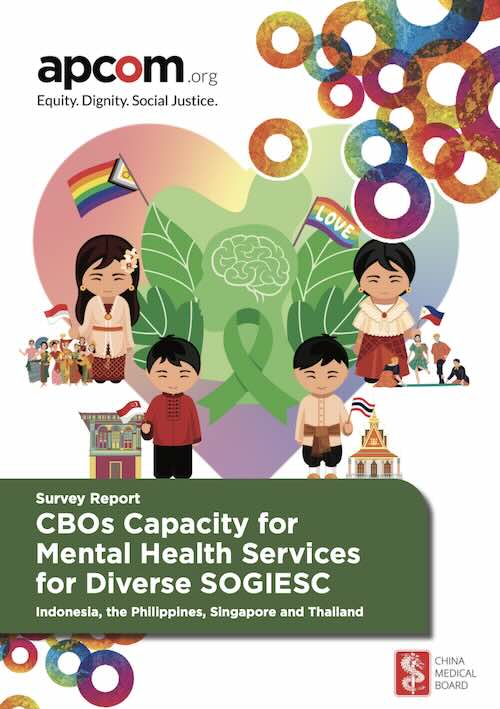
To commemorate World Mental Health Day on 10 October 2025, APCOM, in collaboration with national partners in Indonesia, Singapore, the Philippines, and Thailand, and Institute for Population and Social Research at Mahidol University as research partner – proudly launches a landmark report – CBOs’ Capacity for Mental Health Services for Diverse SOGIESC in Southeast Asia.


“LGBTQI people experience mental health struggles. Research found that LGBTQI of all ages disproportionately are suffering instances of stress and poor mental health due to social discrimination, family rejection, harassment, and fear of violence, etc. Still, the availability and accessibility to mental health services for LGBTQI is limited in many settings. This project is, therefore, very necessary in terms that it will address the mental health issues faced by LGBTQI people and also advocate for the service to be more available and accessible. The research part of the project is expected to provide strong evidences to support the advocacy,”
Asst. Prof Dusita Phuengsamran
Institute for Population and Social Research, Mahidol University
This ground breaking report, supported by the China Medical Board, is the first regional report of its kind to provide country-specific data on the capacities of community-based organizations (CBOs) to deliver inclusive and affirming mental health services for LGBTQI communities. Thank you to our community partners GWL-INA (Indonesia), TLF-SHARE (the Philippines), Oogachaga (Singapore), and The Poz Home Center (Thailand) for their leadership on the research in order to provide strong evidence to support the advocacy for their communities.

“This report demonstrates community leadership in developing culturally relevant strategies to support the mental health of LGBTQI populations in their country, and also mapping of community-led service delivery that can integrate mental health services for their diverse communities,”
said Midnight Poonkasetwattana, Executive Director of APCOM.
“As we mark World Mental Health Day, we call on governments, funders, and allies to work with us to ensure mental health care is not a privilege, but a right accessible to every LGBTQI person in Southeast Asia.”
LGBTQI people experience mental health struggles, and research found that LGBTQI of all ages disproportionately are suffering instances of stress and poor mental health due to social discrimination, family rejection, harassment, and fear of violence, etc. Still, the availability and accessibility to mental health services for LGBTQI is limited in many settings. This project is, therefore, very necessary in terms that it will address the mental health issues faced by LGBTQI people and also advocate for the service to be more available and accessible.

“People living with HIV are getting older as they now live longer, as the mortality rate is decreasing. Elder LGBTQI living with HIV experiences non-communicable disease, they are feeling the pressure of economic, social and family issues – it makes them more vulnerable to mental health. Therefore, mental health services for LGBTQI living with HIV should start now.”
Somchai Phromsombut
Executive Director, The Poz Home Center,
Thailand

“Ill mental health such as depression, anxiety and suicide ideation are experienced more by young queers, transgender and gender diverse persons than their straight and gender-conforming peers. Armed with strategic information, communities and government institutions must work together to address LGBTQIA mental health issues and the social factors that nurture the problem.”
Ferdie Buenviaje
President, TLF Sexuality, Health and Rights Educators Collective (TLF SHARE),
Philippines
Key Country Findings
The report uncovers stark disparities across the region:
- Thailand: Out of 561 respondents, 42.8% reported persistent sadness or downheartedness, with 2.8% experiencing severe depression. Cost and insurance remain the top barriers (41.4%) to accessing services. Only 28% expressed a need for mental health services, but nearly a quarter could not access them.
- Indonesia: More than 50% of LGBTQI respondents reported ongoing sadness, with an average PHQ-9 score of 6.09 (mild depression). Despite 72% indicating a need for services, only 33% accessed them, while 36% sought but did not receive care.
- Philippines: Almost 47% reported constant unhappiness, with a higher prevalence of depression compared to the general population (average PHQ-9 score 8.36 – moderate depression). Of those who needed services (57%), only 27% received them.
- Singapore: The highest levels of distress were recorded, with 79% reporting sadness and an average PHQ-9 score of 10.46 (moderate depression). Despite this, 71% accessed mental health services, showing relatively stronger availability, though 28% were unaware of LGBTQI-specific services.
Across all countries, the majority of CBOs still focus primarily on HIV/AIDS service delivery for prevention, treatment rather than on mental health. Most operate with fewer than 10 staff members and lack trained mental health professionals. Funding shortages and insufficient government policies were consistently identified as major barriers.

“In our experience of supporting Singapore’s LGBTQI community since 1999, we have found that mental health issues have always been part of our work, and increasingly becoming more important in recent years. There exists a whole range of diverse interconnected issues, unmet needs, and potential for service development in this area, not just in Singapore but also in the region.”
Leow Yangfa (he/him)
Executive Director, Oogachaga,
Singapore

“This [research] aligns with our vision to ensure that our community not only survives but thrives, with dignity and equal rights. Our work, grounded in research and community needs, advances policies and programs that uphold the sexual and reproductive health rights of all our members, contributing positively to gender equality and human rights.”
Hamdani
Monitoring and Evaluation Officer, GWL-INA,
Indonesia
Beyond Dissemination – Turning Data Into Action
This launch is not the conclusion, but the beginning of a stronger regional response. Moving forward, APCOM and its partners will:
- Develop National and Regional Strategies: Using the findings to create actionable roadmaps tailored for each country.
- Build CBO Capacity: Designing training programs to equip CBO staff with LGBTQI- sensitive mental health knowledge, counseling skills, and referral mechanisms.
- Advocate for Policy Change: Engaging with ministries of health, social development, and education to ensure LGBTQI mental health is integrated into public health frameworks.
- Strengthen Collaboration: Facilitating partnerships between CBOs, healthcare providers, and governments to expand inclusive service provision.
- Public Campaigns and Awareness: Leveraging World Mental Health Day and beyond to challenge stigma, increase visibility, and promote mental health as a universal human right for LGBTQI people.
- Invest in Sustainability: Encouraging donor and private sector investment—financial and in-kind—to secure long-term systemic change.