


Contributors:
Selvan Anthony / Abhina Aher
APCOM
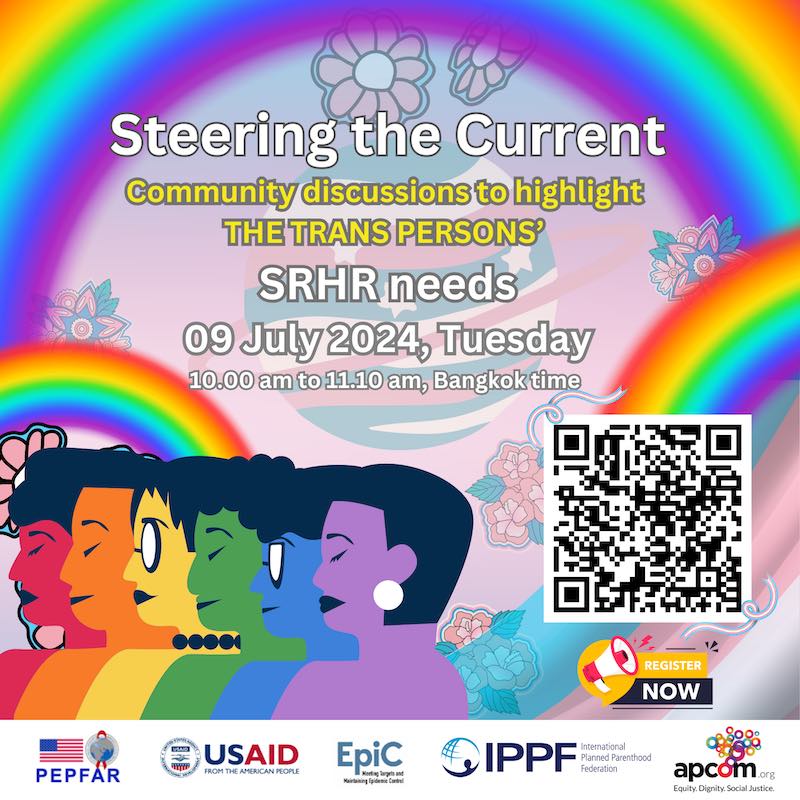
Community-led discussions “Steering the Current: Community discussions to highlight the Trans persons SRHR needs” was held online on 9 July 2024 to highlight transgender sexual and reproductive health and rights (SRHR) and health needs was organized by APCOM, in partnership with EpiC and IPPF SEARO to amplify the missing health response and increasing the need for the health system strengthening (HSS) and reduction of the healthcare stigma in Asia Pacific region.
Transgender women are among the key populations who are most heavily affected by HIV. Globally, an estimated 19% transgender people are living with HIV. The chance of acquiring HIV is 49 times higher for the transgender women than all adults of reproductive age. Estimates suggest that globally, the transgender population could be 0.1 – 1.1 % of reproductive age adults. Country reports suggest that HIV prevalence for the transgender sex workers is on average nine times higher than for female sex workers and three times higher than male sex workers. One of the most significant reasons for transgender being left behind is stigma at the healthcare.
Evidence suggests that, in some settings, a significant proportion of young transgender women engage in selling sex. This is often a result of social exclusion, economic vulnerability and difficulty in finding employment. Transgender people are vulnerable to arrest in those countries that criminalize cross-dressing. Exposure to transphobia is a mental health risk for transgender people and can result in increased levels of depression and suicidal thoughts. In health-care settings, transgender people often face stigma and ill treatment, including refusal of care, harassment, verbal abuse and violence. Stigma and discrimination in the health system alongside lack of knowledge of transgender people’s health-related needs by health personnel deter transgender people from using services. Transgender women and men are drastically underserved by current treatment efforts and report lower rates of treatment adherence than other groups. Despite evidence of heightened HIV vulnerabilities and risks, resulting in high HIV prevalence among transgender people, the coverage of HIV prevention programmes among transgender people remains poor across all regions.

Sylvester Merchant, Community Engagement Officer IPPF SEARO, started off the webinar with highlighting IPPF global response for the LGBTQI+ inclusion on the SRHR needs as per their new global strategic plan. IPPF strategy has four pillars: Center care on people; Moving the sexuality agenda; Solidarity for change; Nurturing our federation. IPPF explicitly delved into the multifaceted aspects of sexual rights and health pertaining to the LGBTQ and intersex communities. The research not only highlighted the specific health needs of these individuals but also outlined detailed recommendations for providing non-discriminatory and crucial health services tailored to their unique requirements. Member organizations of IPPF, especially the organization in Nepal and India already started gender affirming hormone therapy in the in-house trans clinics. FPA, one of the member organizations of IPPF, also supports implementing the GF HIV intervention programme. IPPF has collaborated with APCOM to organize webinars to have meaningful discussions, share valuable insights, and drive impactful actions and benefit communities.

Nicha Rongnam, focal point for the transgender programme at FHI 360, EpiC Thailand, also gave opening remarks, briefly talked about the EpIC programme. She spoke about integrating the transgender health package with EpiC partners in Thailand and across the region that they support. The enabling environment is an important area for the trans community, where they can feel safe, supported, and empowered to access the services or resources that they need, without fear or stigma. Comprehensive healthcare for transgender individuals includes not only HIV-related services but also gender-affirming care, mental health support, and general medical care. Enabling an environment ensures easy access to affordable health services meeting the needs of the transgender community. By implementing a comprehensive approach, we have the potential to bring an end to the HIV epidemic. Our commitment lies in fostering an enabling environment and empowering communities.

Abhina Aher, the consultant of APCOM, talked about trans health and human rights in Asia and the Pacific region. She highlighted that SRHR is more centric for cis-women, however, this is important for all, and it includes sexuality, human rights, and SRHR should be systematically served for all. Transgender is one term under the big umbrella, and in the Pacific there are 14 genders. We have to constantly change the package services because of the diversity of people under the transgender umbrella.
Abhina highlighted there are 6 priorities for the trans community; Access to safe abortion; Fight against sexual and gender based violence; Comprehensive sexuality education; Transformation of masculinities; Equality and access to rights for LGBTQI people; Protecting SRHR in times of crisis. There are several challenges for the trans community to access SRHR services, and it needs to be addressed by designing a comprehensive health programme.

Marli Gutierrez-Patterson is a Senior Programme Officer at APTN, and talked about APTN’s work on CBM tools, which is a comprehensive tool for the trans community. This tool focuses on different aspects – 2 of the aspects for the community members and the remaining 2 are for the health care providers and health clinics. This tool is developed for self-assessment and to identify gaps and challenges and then create action plans. The CBM score card in the tool allows the trans gender community members to assess the services they access. APTN has carried out CBM in 11 countries, where they directly worked with the partners, to carry out the about 30 clinic visits in each country. Subsequently, the assessment was done using the CBM tool, and some findings surfaced; Stigma and discrimination, lack of knowledge on providing gender affirming care; lack of safety and well being. It is really important to ensure that gender sensitivity training is included at all levels of care, not just for direct healthcare providers. This tool covers 12 topics, and it is available in eight languages. Currently, they are providing training for trainers in some countries on CBM tools.

Dr Amit Harshana, from AKESO Health, spoke about the holistic response on Trans gender affirming health care in India. AKESO has established transgender clinics with the motto to present sexual wellness center for the trans community in India. AKESOs focus is to conduct some research to build evidence for creating enabling policies for the trans community. Gender affirmation usually starts with the mental health component, followed by hormone therapy and then gender reassignment surgeries – they noticed huge gaps. They started giving letters of recommendation for Gender Affirming Care. The in-house mental health professionals support the communities throughout their gender affirmation surgeries. For the gender affirmation surgeries, they have in house senior cosmetic surgeons to provide advice to the communities going through gender affirmation surgeries. We also intended to generate evidence about health care services and then use it for policy development.

Sherqueshaa, from Asia Pacific Network for Sex Workers (APNSW), commented “I am proud to be transgender and sex worker. Many has over looked the trans gender in the sex work industry. I am very particular about my health as a trans gender and also a sex worker”. Transgender health care and trans gender doing sex work, sometimes they overlap. Based on her experience, many would then result in to black market services for hormonal replacement therapy. This should be changed because there are many health care providers who can provide required services to the trans community.

Nachale Boonyapisomparn (Hua), Transwoman activists, also spoke about trans health care in Thailand. She highlighted that trans communities pay from their own pocket to access gender affirming care. Also, they face stigma and discrimination when accessing the services. Gender affirming care services, its affordability is a big challenge in Thailand. The Ministry of Health should look into these challenges and provide some solutions to make it more affordable and accessible for the trans community to access gender affirming care services. Community health care providers have gained adequate knowledge about trans issues, and they can provide better services to the trans community. In Thailand, we have small group doing gender affirming care, and they need support from the community. Gender affirming care should be promoted to improve the overall health of transgender communities.

Swastika Lama, Clinic Manager Family Planning Association of Nepal – Started the Hormone Replacement Therapy (HRT) and Beautician clinic in Nepal. There are several challenges; Stigma and discrimination; Health care systems biases and providers attitudes; Lack of legal recognition for transgender individuals; Medication access regulatory hurdles. They have been trying to collaborate with the government to ensure sustainability of their work. In Nepal, there is a lack of awareness about HRT, and hence they are providing training to the communities and health care providers to ensure better services to the communities.


The webinar was concluded by Abhina Aher, she expressed that we need stronger commitment in the region towards the transgender health, visibility and leadership. Health issues included SRHR needs ‘Holistic One Health’ approach for the transgender people in the region. Human rights and alignment of the Sustainable Development Goals (SDG) and Universal Health Coverage (UHC) are some of the important principles that must reflect at the donor, implementer and beneficiary level. Legal and policy framework is changing for the transgender people due to the various advocacy efforts; it’s essential that we consider ‘Health is Human Rights!’ for the transgender people as well and work towards the intersectionality including sex work vulnerabilities and adolescent trans health in the long run.

At the end APCOM, represented by Selvan Anthony thanked all the donors, participants, APCOM staff and communities who actively participated in the webinar and created rich discussions around the subject matter.
Agenda
| Time | Activity | Speaker |
|---|---|---|
| 05 mins | Welcome and Introductions – Housekeeping – Overview of session – Introduction of the speakers | Abhina Aher, APCOM |
| 10 mins | Key note the speech | Nicha, PEPFAR/USAID/EpiC Sylvester Merchant, IPPF |
| 15 mins | Where are we in the Trans health and Human Rights in Asia and Pacific region | Abhina Aher, APCOM |
| 20 mins | Panel discussion: Strategic approach for trans health and human rights | Chair: Abhina Aher Panel discussions · Dr Amit Harshana, AKESO Health · Marli, Asia Pacific Transgender Network · Sherry, Asia Pacific Network for Sex Workers · Nachale Boonyapisomparn (Hua), Transwoman activists. |
| 15 mins | Transforming Healthcare: Insights on Inclusive Health within a Broader SRHR Context | Swastika Lama, Clinic Manager Family Planning Association of Nepal |
| 10 mins | Closing Remarks and thanking note | Abhina Aher, APCOM |
This article supported by:

See also:
We asked trans and gender diverse groups in five countries
“What are the barriers to receiving gender-affirming care in your country?”
in India, Nepal, Pakistan, Philippines and Sri Lanka, and here are there recommendations:

“Sensitization in all healthcare systems is necessary, there have been several incidents regarding the stigma towards transgender people. We also need to make amendments to the existing medical curriculum and third and more importantly, we need to have several interventions supporting the enabling environment for gender affirmation services. We need to strengthen the services at the state level so at least one public healthcare system can avail the services. I also feel we need to provide the skills to the community members, because communities can serve the other communities on gender affirmation care would be the best methodology/ approach to work.”
Trans activist India

“A major barrier is that [gender-affirming care] services are not available in many countries. That’s why people need to travel from one country to another…also the prices are not affordable for the trans people, and doctors may not be equipped for the good surgery services [in my country]. In countries like Nepal, we have reached out to some surgeons, they said they can do it, however, they need to have first the concrete policy from the government on this.”
Trans activist Nepal

“I want to emphasize the importance of sensitizing individuals about hormonal therapy for gender affirmation. Many Khawaja Siras (Pakistan’s transgender community) lack awareness about their own body type and the specific hormones that would best suit their needs. Instead of seeking professional guidance, they often rely on the choices made by their friends, leading to potential complications and side effects when their bodies reject the hormones.
To address this issue, it is crucial to have a law in place that specifically addresses the concerns and requirements of gender affirming hormonal therapy.”
Trans activist Pakistan

“Discrimination is a factor that prevents us from seeking gender-affirming care services. A friend who went to a hospital was declined by an Endocrinologist because admitting trans people was against his religious belief.”
“Lack of understanding about transgender people including their rights and health needs is the reason why they have challenges accessing gender-affirming care services. While trans people are confused about the right way to take gender-affirming hormone therapy, health professionals are also clueless about it.”
“We can tap into private institutions to work with the government to further the gender affirmation care services in the country and organize some meetups for awareness campaigns led by trans organizations”
Trans activists Philippines
“Lack of knowledge of the staff members at the service provision centres, hospitals and personal attitude of service providers towards the [trans] community are the main issues that we have seen as the barriers. Also, trans health care and services are not recognised as an important need in the medical platforms.
Providing ongoing training to the service providers and including gender identities to the training curriculum would be a successful initiative which we can take and making non-discrimination policies within the service providing institutions would protect the rights and dignity of the community members.”
Trans activist Sri Lanka